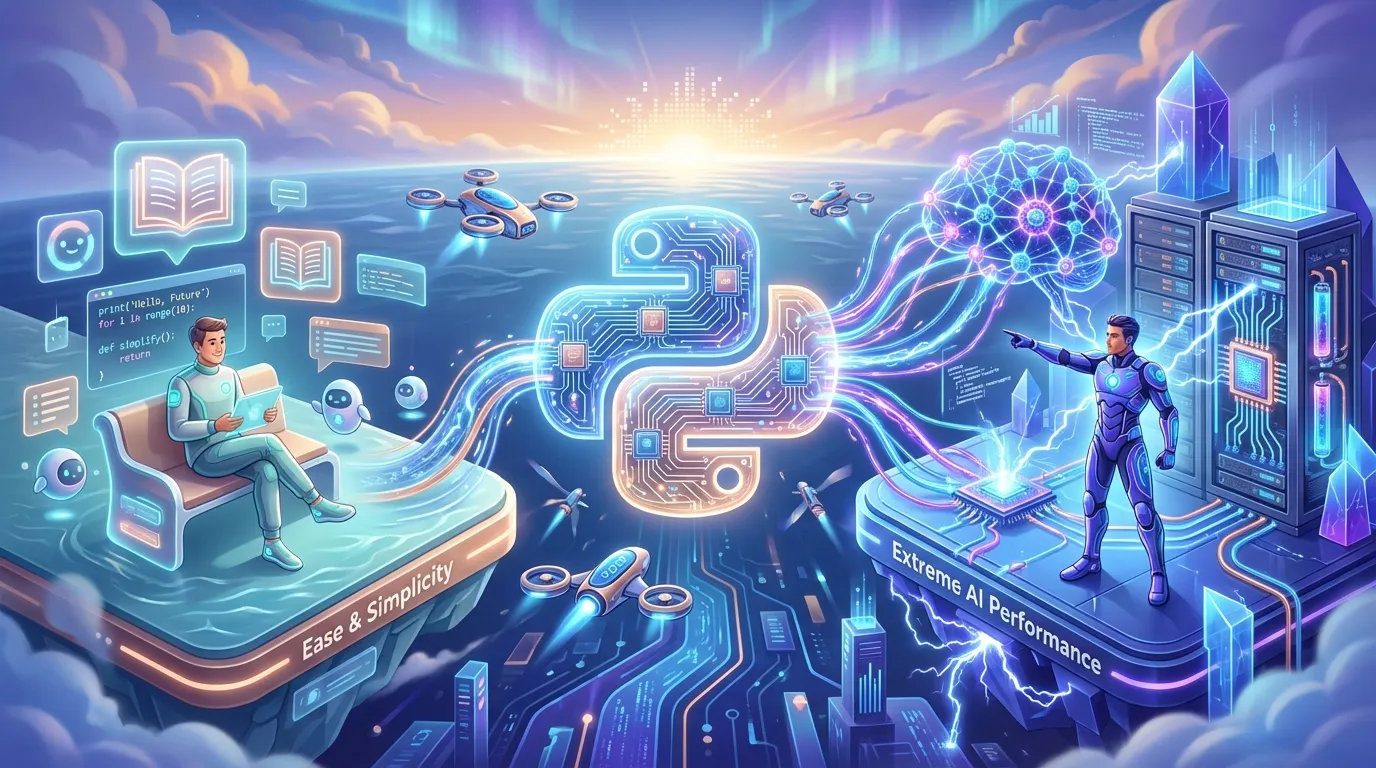
In 2026, Python is not fading away; it is evolving. This programming language is adapting aggressively to balance user-friendliness with the extraordinary performance demands of future machines. Instead of being displaced by the massive computational needs of Artificial Intelligence (AI), the tech industry has discovered creative ways to keep Python relevant through system optimization and seamless collaboration with faster, newer technologies.
The world of AI is moving at a breathtaking pace. To understand how this beloved language is adapting, we need to look at the broader development landscape.
A Strong Foundation in the AI Ecosystem
Before discussing the challenges, let's examine why Python’s foundation remains unshakable, even as technological standards continue to rise.
Syntax Simplicity Accelerates Innovation
Python's greatest strength lies in its human-readable and intuitive language. According to global developer surveys, Python's conciseness allows researchers and data scientists to focus on crafting brilliant AI logic without spending hours debugging rigid syntax rules common in C++ or Java.
World-Class Library Support
Python possesses a mature ecosystem of "weapons." AI giants like TensorFlow (developed by Google) and PyTorch (from Meta) have treated Python as their primary home from the start. This availability of ready-to-use libraries makes the AI design process significantly more efficient and structured.
Meeting Future Computing Standards
Of course, innovation brings its own set of challenges. As AI becomes smarter, workloads increase drastically, and this is where Python must improve.
Surging Scale of AI Model Parameters
Modern AI models, such as Large Language Models (LLM), now operate with billions to trillions of parameters. OpenAI research reports indicate that the computational power required to train advanced AI systems doubles every few months. This massive data scale demands hardware-level processing efficiency—an area where Python requires an extra boost.
Optimizing "Interpreted" Language Characteristics
By nature, Python is an interpreted language, meaning the computer translates code line-by-line during execution. While this provides flexibility, it creates a performance gap compared to compiled languages like Rust or C, which integrate directly with machine code. This is the exact challenge global software architects are currently solving.
Adaptation Strategies and Tech Collaboration
Rather than abandoning Python, developers are taking a smarter route: collaboration and system upgrades.
Cross-Language Hybrid Approach
The most popular solution today is combining the best of both worlds. Developers continue to use Python for designing interfaces and core logic due to its practicality. However, heavy mathematical calculations in the background are outsourced to C++. In short, Python acts as the architect designing the building, while C++ is the high-powered foreman executing the work.
Synergy with Next-Gen Ecosystems
Adaptation also comes from outside the original ecosystem. New languages like Mojo have emerged, specifically designed for AI needs. Interestingly, Mojo’s creators do not intend to "kill" Python. Instead, they designed a syntax fully compatible with Python but with performance speeds equivalent to C. This offers a seamless exit: developers don't have to discard their Python knowledge while still enjoying maximum speed.
Frequently Asked Questions (FAQ)
1. Why does Python need optimization for future AI?
Because modern AI models require processing trillions of data points in real-time. As an interpreted language, Python needs optimization and assistance from other languages to ensure heavy computational tasks run efficiently without lag.
2. Will Python's role be completely replaced by 2026?
Very unlikely. Python's community and support ecosystem are too massive. Its role will simply adapt; from working alone to becoming a control hub that collaborates with other programming languages behind the scenes.
3. How do developers overcome Python's speed limitations?
The most popular solution is a hybrid approach. Developers write drafts and program logic using Python for speed of development, then delegate complex data calculations to faster languages like C++ or utilize new compatible ecosystems like Mojo.
The tech world will keep spinning, and the ability to adapt is the ultimate key. A programming language is essentially a tool to realize big ideas. To ride the wave of rapid Artificial Intelligence development safely, having a strong foundation in logic is the best investment you can make.
Want to stay updated with future technology and master industry-relevant skills? Build your digital foundation by learning coding and robotics in a fun and structured way. Visit Koding Akademi now and start your journey to becoming a skilled tech creator!