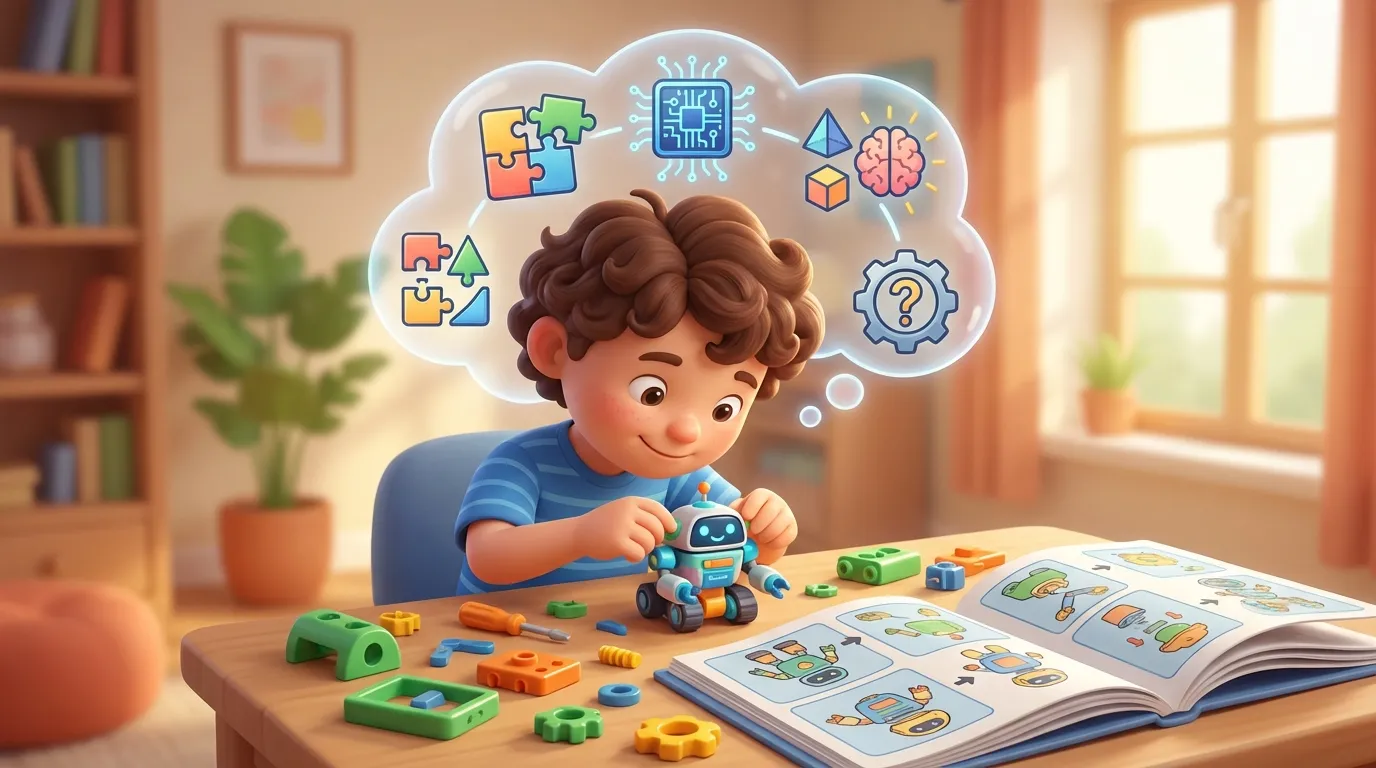
Model assembling is not merely an old-fashioned hobby, but rather a highly effective tool for training children's brains to think logically, enhancing memory capacity, strengthening visual-spatial abilities, and building mental resilience. Amid the deluge of gadgets that often leave children passive, this hands-on activity of putting pieces together actually provides targeted cognitive stimulation that is crucial for academic foundations and their future success.
Why Is the Assembling Activity So Impactful?
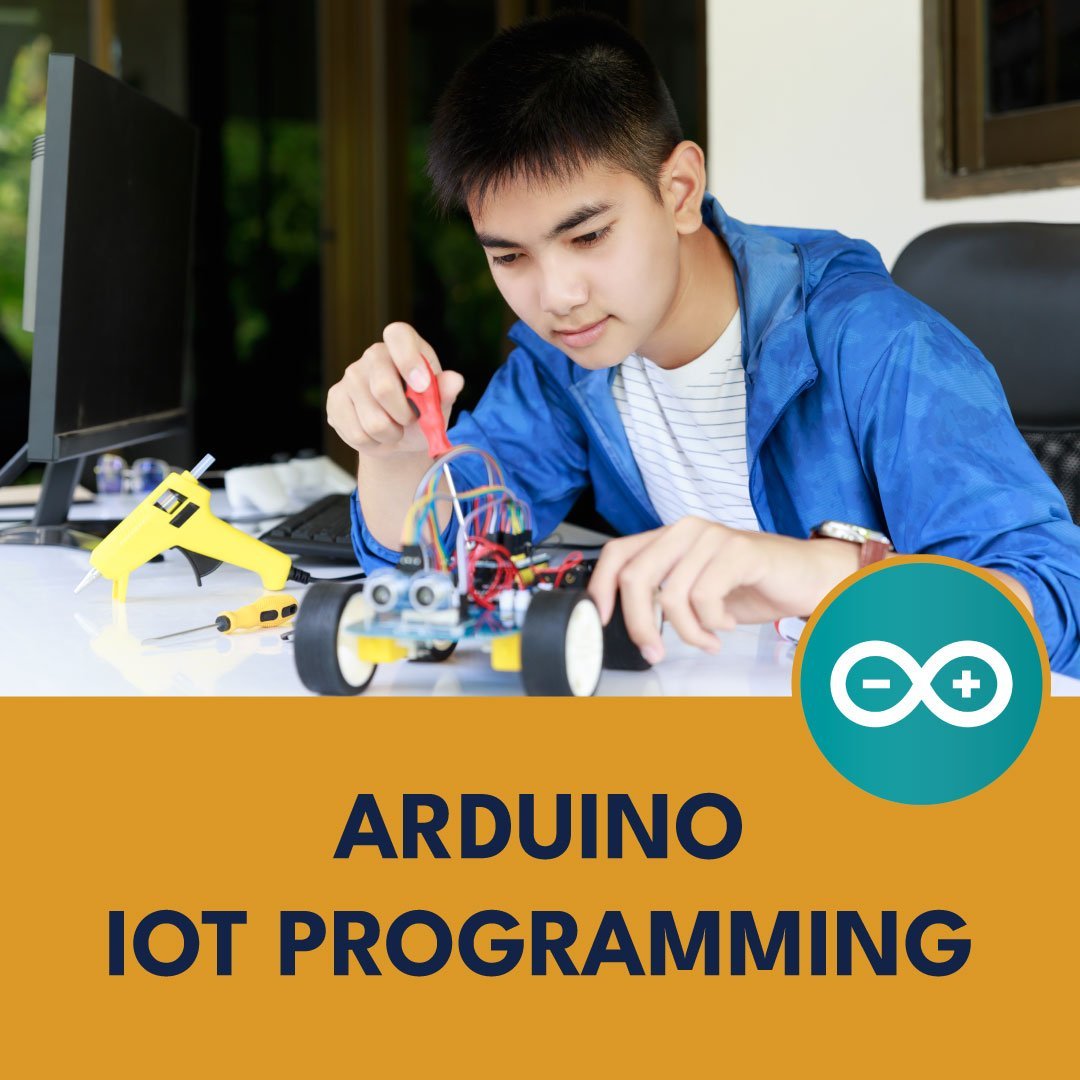
Parents often view sitting still and assembling blocks or miniature models merely as a way to keep children from becoming fussy. However, when a child is focused on tinkering with their assembly project, their brain is working hard to absorb various important skills.
1. Training Cause-and-Effect Logic Directly
Model assembling teaches children about cause and effect relationships in the most practical way. If even a single component is positioned incorrectly, the final result will definitely not match the intended shape. From these small mistakes, children are forced to analyze, compare, and correct the issues themselves. According to various child development studies, the ability to solve problems independently is one of the most essential 21st-century soft skills needed in today's modern workplace.
2. Sharpening Memory and Adherence to Instructions
To produce a perfect assembly, children cannot simply place pieces randomly; they must carefully read and follow the sequence of steps in the instruction manual. This process is excellent for stimulating short-term memory and cultivating patience. Interestingly, the habit of following structured instructions aligns with the fundamental concepts of computational thinking, which is now increasingly applied in international standard curricula, particularly in STEM education (Science, Technology, Engineering, and Mathematics).
3. Honing Visual and Spatial Intelligence
Assembling three-dimensional structures requires children to visualize the final form from small fragments that initially appear disorganized. This skill of imagining and manipulating objects in one's mind is called visual-spatial intelligence. Numerous scientific and cognitive psychology studies show that children with strong spatial abilities tend to grasp mathematics, geometry, and science and technology more easily as they grow older.
4. Building Mental Resilience and Growth Mindset
From a character-building perspective, this activity is a wonderful teacher. Children often have to disassemble nearly their entire project because of a single error made at the beginning. These moments of frustration are actually valuable mental training. Psychologists often associate this with growth mindset—a way of thinking where failure is not viewed as a dead end, but rather as a natural part of the learning process. Children become accustomed to bouncing back and trying again without giving up easily.
Parental Support is the Key
The good news is that you don't need to spend a fortune on complicated equipment. The most important thing your child needs is opportunity and support from parents. Let them explore and give them full confidence to complete their projects independently. When children successfully complete one model, their self-confidence and sense of responsibility will grow rapidly.
Frequently Asked Questions (FAQ)
1. Is model assembling suitable for children of all ages?
Yes, it is very suitable. The key lies in selecting the appropriate difficulty level. Make sure you provide model kits that match your child's age and motor skills so they feel challenged, not stressed or frustrated.
2. What if my child gets bored quickly and doesn't want to read the instruction manual?
This is very normal in the beginning. The solution is to make the assembling process a collaborative activity. Accompany them and read the instructions together until the child becomes familiar and confident enough to do it on their own.
3. What is the connection between the model assembling hobby and learning technology in the future?
Model assembling trains structured thinking patterns, problem-solving logic, and spatial understanding. These three elements are the primary foundations that are essential when children begin learning programming languages or designing robotics.
Learning to assemble models may seem simple, but its impact on children's cognitive development is truly significant. From this small and enjoyable activity, the foundation of critical, creative, and systematic thinking forms naturally.
If your child has shown interest in assembling activities, stacking blocks, or has great curiosity about how things work, this is a golden moment to direct their potential. Come on, sharpen their logic and technology creativity to the next level by joining interactive coding and robotics classes with Koding Akademi.