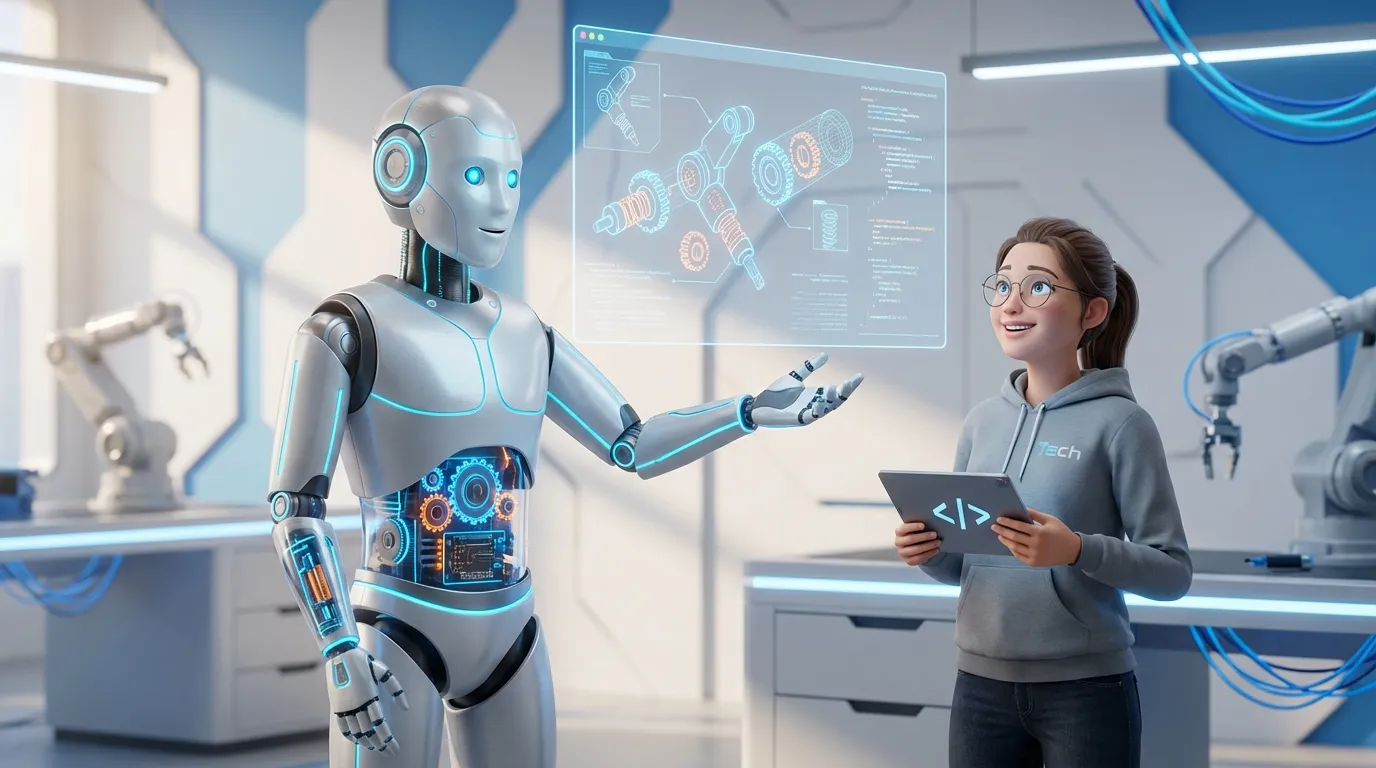
Humanoid robots are advanced machines whose physical forms are specifically built to resemble the human anatomy—complete with a head, a torso, two arms, and two legs. The main purpose of this bipedal (two-legged walking) design is not merely to mimic our appearance, but so that these robots can easily navigate and function optimally in everyday environments that were originally designed for the convenience of human movement.
The technology behind these machines involves a complex blend of mechanical engineering, artificial intelligence, and materials science. To understand them further, let's break down the reasons behind their physical forms and their main driving components.
The Reasons Behind the Human-Like Physical Design
Why do engineers go through the trouble of making robots walk on two legs when using wheels is much easier and more stable? The answer lies in functionality and interaction.
Adapting to Environments Without Spatial Modification
Our world is filled with stairs, varying doors, narrow corridors, and tools. If a robot were a wheeled box, it would struggle to climb house stairs or drive a normal car. The developers behind Boston Dynamics' Atlas project often cite "human-centric environments" as the absolute reason for the necessity of a humanoid form. With the right anatomy, robots can immediately use existing infrastructure without the need for costly spatial modifications.
More Natural Psychological Interactions
In the realm of service or medicine, a human-like form helps reduce awkwardness during interactions. Research conducted by Hanson Robotics—the creator of the Sophia robot—shows that adding realistic facial expressions and eye contact significantly increases human empathy and acceptance of machines, especially in personal assistant or customer service roles.
Vital Robot Mobility Components
Beneath their appearance, there are incredible systems that allow these robots to move like real humans.
Sensor Systems Acting as Senses
Robots need a way to "see" and "feel" the world. They use a combination of cameras, LiDAR, and distance sensors. As a technology reference, the Optimus robot currently being developed by Tesla utilizes the same Autopilot vision system as their electric cars, allowing the robot to map spaces and recognize objects autonomously in the real world.
Actuators as Synthetic Muscles
To step without falling, robots need mechanical joints and muscles called actuators. This technology regulates how strong a robot's arm must be to lift a weight or how precisely its foot must step. This balancing system requires heavy computation. Honda, through its legendary robot ASIMO, pioneered the use of the Zero Moment Point (ZMP) algorithm, which constantly calculates the machine's center of gravity so it doesn't easily topple over when taking a step.
Frequently Asked Questions (FAQ)
1. Are humanoid robots designed to replace all human jobs?
No. Most development focuses on taking over tasks that are too dangerous (like inspecting nuclear reactors), repetitive, or too physically demanding, so humans can focus on work that requires creativity and strategic decision-making.
2. What are the most advanced examples of humanoid robots today?
Some of the most prominent are Atlas from Boston Dynamics, which is incredibly agile and capable of acrobatics, and Sophia, which is highly skilled in natural language processing and social interaction with humans.
3. Why is building a bipedal walking robot so difficult?
Walking on two legs is a continuous battle against gravity. Machines require super-fast sensors and high-level real-time computing capabilities to manage dynamic balance in milliseconds so the robot doesn't fall every time it lifts a foot.
The future of robotics and artificial intelligence technology is moving faster than we can imagine. Understanding how this technology works is not just about keeping up with trends, but also the first step to unlocking numerous promising career opportunities in the future.
Interested in exploring and building your own tech systems? Come hone your future skills by learning coding and robotics at Koding Akademi. Visit the website directly at