To choose the right digital educational book for children learning to read, parents need to pay attention to five key factors: age appropriateness, interactive features, story quality, app safety, and the importance of parental guidance. These five factors directly influence the effectiveness of learning while building children's enthusiasm and confidence.
Why Are Digital Educational Books Effective for Children?
Digital educational books combine visual, audio, and interactive elements in one medium. According to research published in the Journal of Early Childhood Literacy (2020), children who learn to read with interactive digital media show faster improvements in phonics comprehension and vocabulary compared to print media alone, especially when accompanied by parental guidance.
However, their effectiveness greatly depends on how they are chosen and used. Not all digital books are specifically designed to optimally support children's literacy development.
5 Ways to Choose Digital Educational Books for Children Learning to Read
1. Match the Book to the Child's Age and Reading Level
Choosing a book that does not match the child's age can lead to frustration or boredom if it is too easy. Guidelines from the American Academy of Pediatrics (AAP) recommend that digital content for young children be designed with a gradual approach, starting from letter recognition, syllables, simple words, and progressing to short sentences.
- Ages 3–4: Choose books with large pictures, capital letters, and clear audio narration.
- Ages 5–6: Books with short words, sentences of 3–5 words, and supporting illustrations.
- Ages 7 and above: Light stories with complete sentences and simple storylines.
2. Prioritize Interactive Features That Support Phonics Learning
The right interactive features can accelerate a child's understanding of the relationship between letters and sounds, a method known as phonics-based learning. Research from the National Reading Panel (2000) concluded that structured phonics instruction is one of the most effective methods for teaching young children to read.
Interactive features to look for:
- Audio narration with clear pronunciation
- Text highlighted to follow the read-aloud (read-aloud with word highlighting)
- Simple animations relevant to the story, not just entertainment
3. Choose Stories with Positive Messages and Character Values
A good book does not only train technical reading skills but also conveys meaningful values. Based on the Social-Emotional Learning (SEL) framework developed by CASEL (Collaborative for Academic, Social, and Emotional Learning), early exposure to stories with positive values contributes to the development of children's empathy and learning motivation.
Ideal character values in children's stories:
- Honesty and courage
- Curiosity and hard work
- Friendship and mutual respect
4. Verify App Safety and Minimal Ad Interference
A safe digital environment is an absolute requirement before giving children access. Common Sense Media, a nonprofit organization focused on technology and children, recommends that parents choose apps with child-specific ratings, no targeted ads, and no in-app purchases easily accessible to children accidentally.
Characteristics of a safe app for children:
- Certified or recommended by trusted educational institutions
- Does not display disruptive pop-up ads
- Has a learning mode locked from external content
5. Accompany Children During Digital Reading Sessions
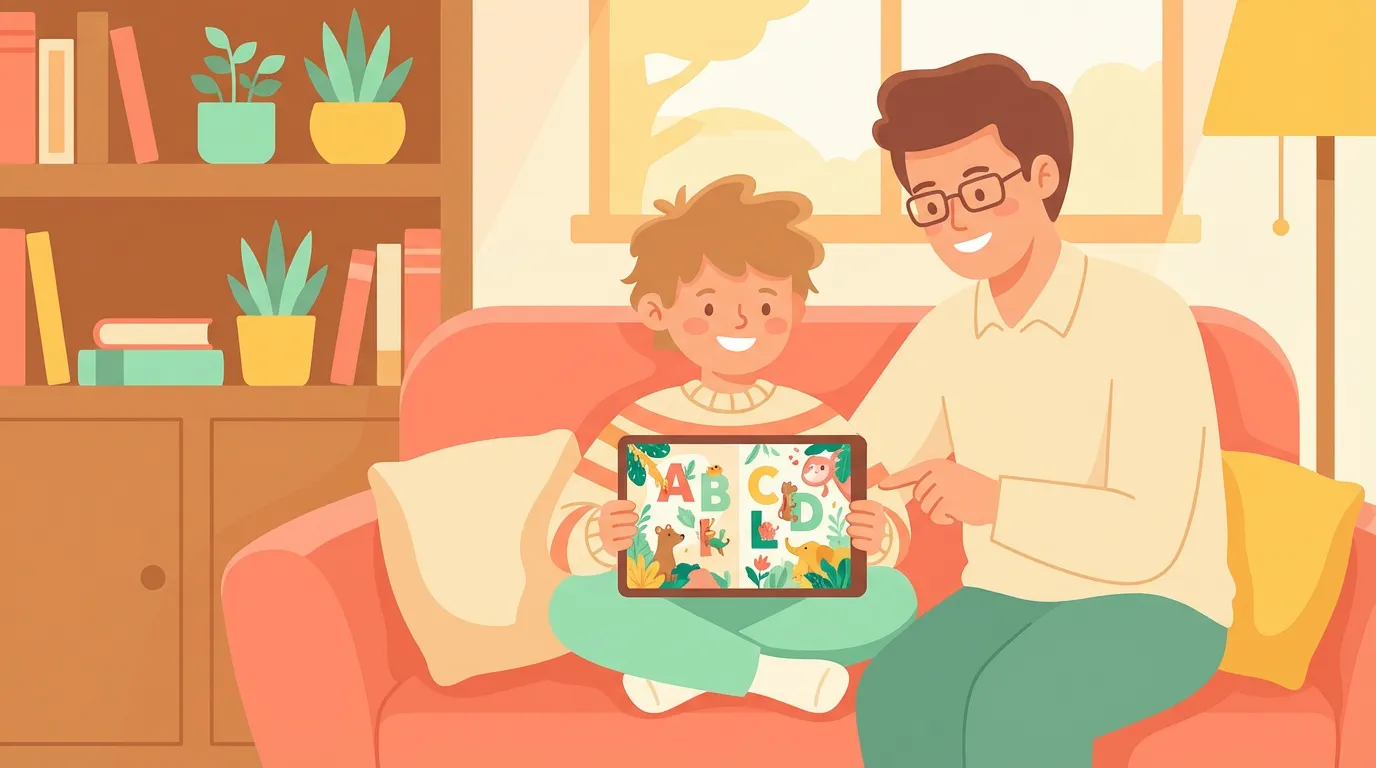
Parental involvement remains the most important factor, even when using digital media. A study from the Harvard Graduate School of Education affirms that parental interaction, such as asking questions about the story, giving praise, and discussing the content, significantly improves children's comprehension and strengthens the emotional bond in the learning process.
Tips for accompanying children during digital reading:
- Sit together and take turns reading aloud
- Ask the child's opinion about characters or the story
- Give specific praise, such as "You read that sentence so smoothly!"
Frequently Asked Questions (FAQ)
Q: How long should children ideally use digital educational books per day?
A: According to guidelines from the WHO and AAP, children aged 3–5 should spend no more than 1 hour per day in front of a screen, including educational activities. For school-age children, a limit of 1–2 hours with active breaks every 30 minutes is recommended to avoid affecting eye health and sleep patterns.
Q: Can digital books fully replace print books?
A: Not entirely. Literacy experts, including those from the Literacy Research Association, recommend a blended reading approach, combining both print and digital books. Print books train fine motor skills as children point to words, while digital books reinforce phonics and audio-visual comprehension.
Q: How do you know if a child has chosen a digital book that matches their ability?
A: Use the Five Finger Rule: ask the child to read one page, then count the words they cannot read. If more than 5 words per page are unrecognized, the book is likely too difficult. If there are zero difficult words, try moving up to the next level.
Conclusion
Choosing the right digital educational book is not just about an attractive appearance, but about age appropriateness, quality of learning features, platform safety, and the active role of parents in providing guidance. With a well-planned approach, digital books can become a powerful tool for nurturing children's love of reading and self-confidence from an early age.
If your child has started to enjoy reading and is ready to explore the world further, the next equally important step is equipping them with critical thinking skills through coding. Start your child's coding learning journey today at kodingakademi.id, a children's coding learning platform designed to be fun, structured, and relevant for the digital future.