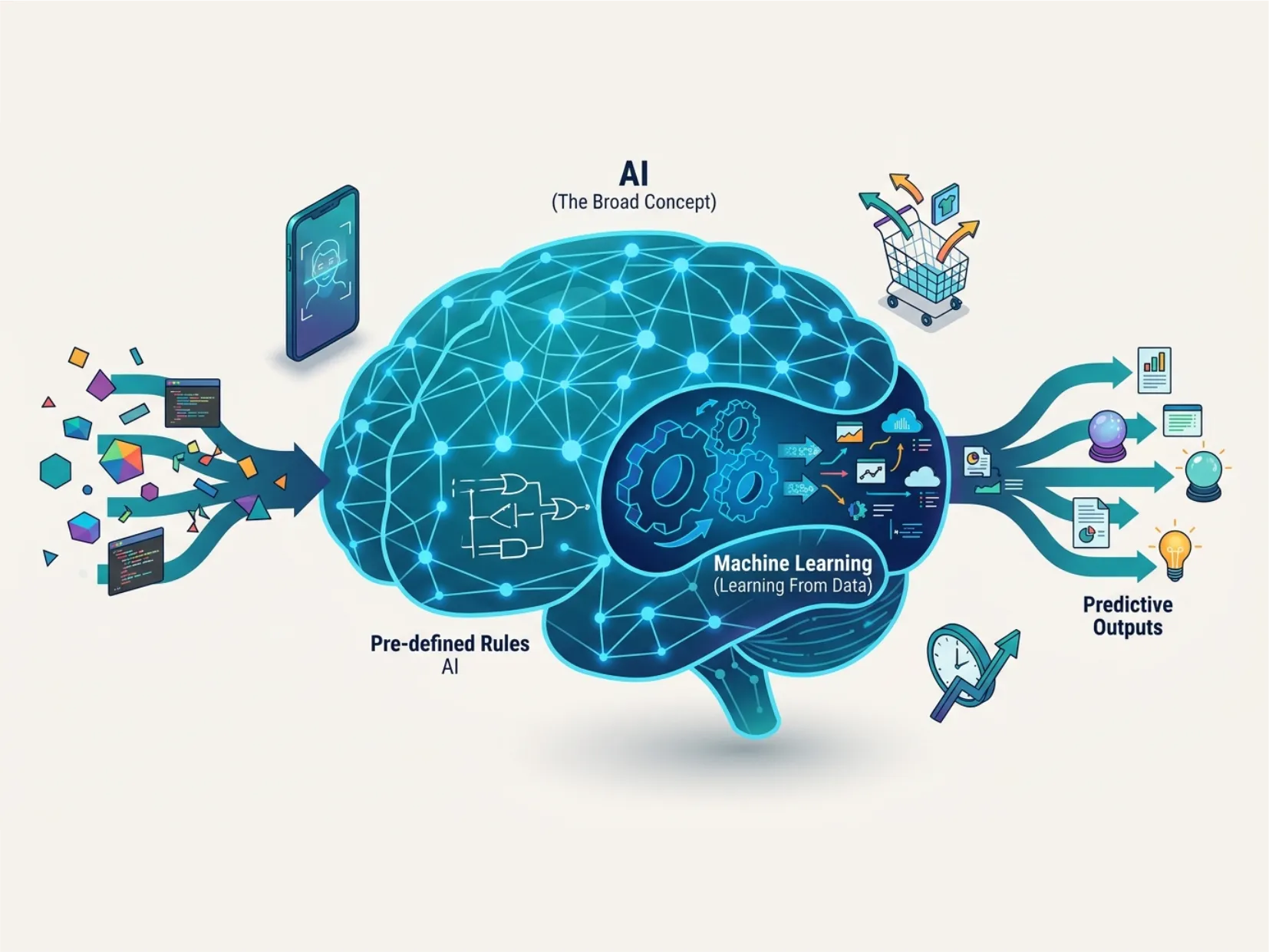
The fundamental difference between AI and Machine Learning lies in their scope: AI is the broad concept of machines mimicking human intelligence, while Machine Learning is a specific method within AI that allows machines to learn independently through data. Although often considered the same, understanding that Machine Learning is a subset of AI is crucial to seeing how this technology operates in our daily lives.
AI: The Umbrella of Artificial Intelligence
Artificial Intelligence or AI is a vast technological vision. Its goal is to create systems capable of performing tasks that typically require human intelligence.
Definition and Basic Capabilities of AI
AI encompasses various ways for computers to imitate human abilities, such as reasoning, decision-making, and understanding human language. The approaches within AI are diverse, ranging from simple manual logic rules to highly complex artificial neural networks.
AI Implementation in Life
In practice, general AI can operate based on rules pre-determined by developers. Simple examples can be found in systems that follow logical instructions to complete specific tasks, such as facial recognition or digital assistant applications.
Machine Learning: Learning Through Data
If AI is the goal, then Machine Learning is one of the most popular paths to achieve it. Here, the "learning" aspect becomes the primary focus.
Replacing Rigid Rules with Data Patterns
Unlike rigid programmed systems, Machine Learning focuses on a system's ability to learn directly from data. Instead of being given manual instructions for every possibility, these systems are trained using large amounts of data so they can find patterns and make predictions automatically.
Automatic Performance Improvement Process
One unique characteristic of Machine Learning is its ability to evolve. As more data is learned and processed, the results or predictive accuracy generated by the system typically improve over time. This reliance on the learning process from data is what enhances its performance.
The Relationship Between the Two
To simplify the understanding, imagine a Venn diagram. All Machine Learning systems are part of AI, but not all AI systems use Machine Learning methods.
Understanding this difference helps us realize that advanced technologies, such as product recommendations in shopping apps, are not just ordinary programs, but the result of systems that continuously learn from user habits.
Frequently Asked Questions (FAQ)
1. Can AI function without Machine Learning? Yes, AI can work using simple logic rules or expert systems programmed manually without requiring a learning process from data.
2. What makes Machine Learning special? Its advantage lies in its flexibility; it does not require rigid rule programming and is capable of finding hidden patterns in large volumes of data to make automatic predictions.
3. Why do people often confuse AI and Machine Learning? This happens because most of today’s most popular AI breakthroughs, such as facial recognition and product recommendations, are actually driven by Machine Learning technology.
In this rapidly evolving digital era, technological literacy is no longer an option—it is a necessity. Understanding the foundations of artificial intelligence and how machines learn will be an invaluable skill in the future. If you want to master this technology more deeply and become a part of the future's innovators, let’s start learning coding and robotics in a fun way at