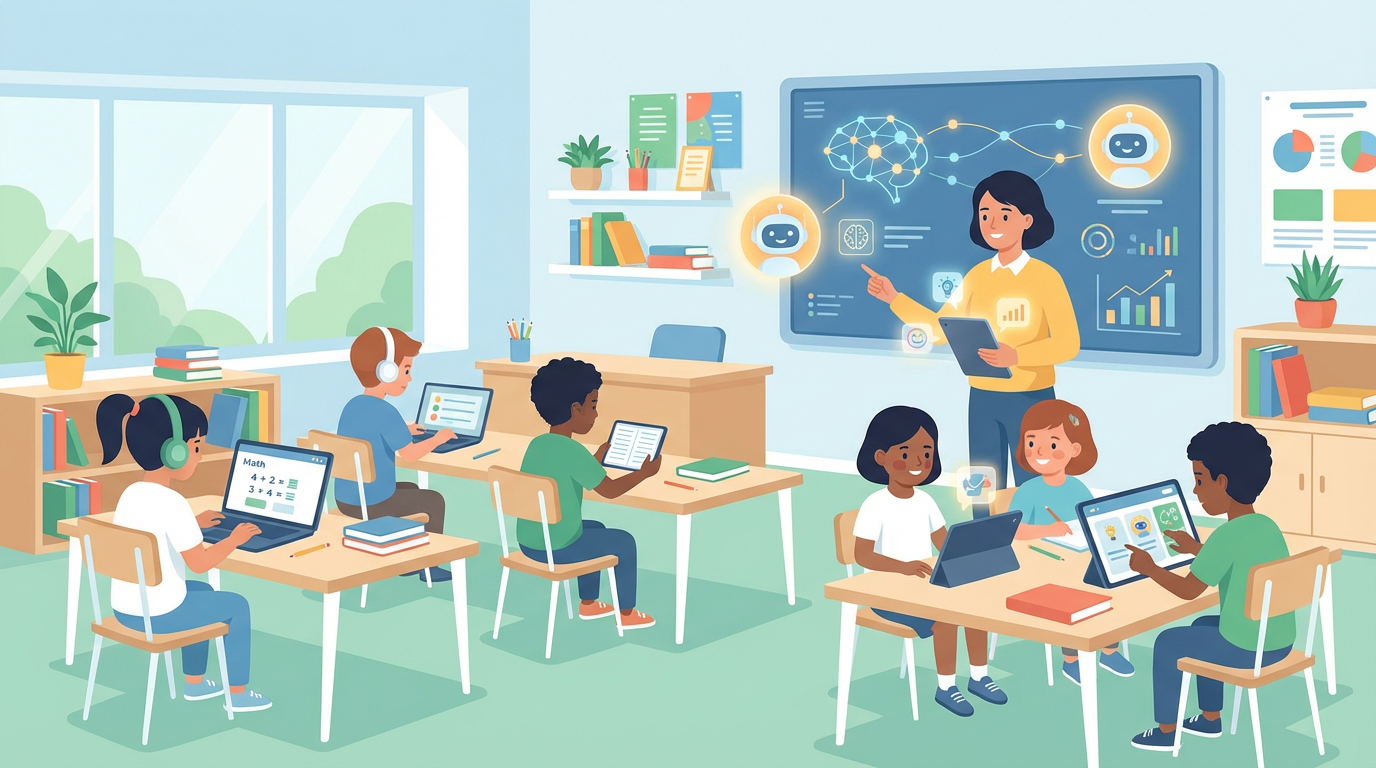
AI in children’s education is indeed necessary, but not simply because it is trending. AI is valuable insofar as it helps make learning more personalized, provides faster feedback, and reduces teachers’ administrative workload—without replacing the human role. This view aligns with UNESCO, which emphasizes that educational technology should be used for clear pedagogical purposes, not adopted merely because it appears modern (UNESCO, Global Education Monitoring Report 2023/24).
Why AI Deserves a Place in Children’s Education
Learning can adapt to each child’s pace and ability level
One of the most practical needs for AI in education is personalization. Not all children learn in the same way or at the same speed: some understand visual explanations quickly, some need step-by-step guidance, and others require more practice. Adaptive learning systems and intelligent tutoring systems are designed to adjust materials, difficulty levels, and types of support based on student performance. Meta-analyses show that these approaches can improve learning outcomes compared with non-adaptive instruction in many learning contexts (Ma et al., 2014; Kulik & Fletcher, 2016).
This means AI is not just a “sophisticated feature,” but a tool that can help children learn according to their needs. This is especially important for children who often feel left behind—or, on the contrary, not challenged enough—in uniform classroom settings.
Practice feedback can be faster and more specific
Children learn more effectively when they receive feedback soon after practicing, rather than having to wait too long. AI can help check objective answers, provide step-by-step hints, and recommend remedial or enrichment materials. In its guidance on the use of generative AI in education, UNESCO notes that AI has the potential to support fast and targeted learning assistance, as long as the results are still verified by educators (UNESCO, Guidance for Generative AI in Education and Research, 2023).
This speed of feedback matters because children can immediately identify where they went wrong and correct it before misconceptions become stronger.
Teachers have more time left for human-centered guidance
AI is also relevant because it can help teachers with repetitive tasks, such as summarizing initial materials, drafting practice questions, preparing variations of explanations, or reading general patterns in student learning outcomes. UNESCO emphasizes that the greatest benefit of educational technology appears when it frees up teachers’ time for high-value activities that only humans can do, such as mentoring, discussion, motivation, and relationship-building with students (UNESCO GEM Report 2023/24).
In other words, AI is most useful not when it takes over the classroom, but when it gives teachers more space to become fully present educators.
Why AI Must Not Become the Center of Education
AI output can be wrong, biased, and not always safe for children
Although useful, AI still has limitations. Generative AI systems can produce answers that sound convincing but are wrong, biased, or not age-appropriate for children. UNESCO warns that AI in education brings risks of misinformation, bias, and ethical issues if used without human oversight (UNESCO, 2023). UNICEF also stresses that the use of AI for children must take into account children’s rights, safety, data privacy, and system transparency (UNICEF, Policy Guidance on AI for Children, 2021).
For that reason, education should not be handed over entirely to AI. Children need to be taught to verify information, ask follow-up questions, and understand that AI responses are not always the final truth.
Empathy, collaboration, and reasoning are still built by humans
The purpose of education is not only to make children answer questions quickly, but also to shape their way of thinking, character, and life skills. Through Learning Compass 2030, the OECD highlights the importance of agency, responsibility, collaboration, and well-being in the future of education. The World Economic Forum also lists analytical thinking, resilience, leadership, and social influence among the skills becoming increasingly important in the world of work (WEF, Future of Jobs Report 2023).
All of this points to one thing: children’s education is not enough if it focuses only on information efficiency. Children still need to learn how to cooperate, manage emotions, understand other people’s perspectives, and develop empathy—things that cannot be fully replaced by machines.
Conditions for AI to Truly Benefit Children
Learning goals must be set by teachers, not algorithms
AI becomes useful when it is used to support already-defined learning goals. UNESCO emphasizes that pedagogical decisions must remain in the hands of educators, because good technology serves learning needs rather than directing learning without context (UNESCO GEM Report 2023/24).
In practice, teachers still determine the competencies to be achieved, the methods of evaluation, and the boundaries of AI use. AI only helps with the process; it should not determine the direction of education.
Parental guidance matters when AI is used at home
When children use AI outside school, the role of parents becomes very important. UNICEF recommends adult involvement so children can understand digital safety, data privacy, and how to assess information they receive from AI systems (UNICEF, 2021). Without guidance, AI may make children too dependent on instant answers and less practiced in forming their own thinking.
That is why AI use at home should be accompanied by simple rules: children should try answering first, then use AI to check, clarify, or look for alternative explanations.
Schools must choose child-friendly platforms that protect data
Not all AI platforms are suitable for children. In its 2023 guidance, UNESCO stresses the importance of school policies related to data protection, age appropriateness, transparency of use, and risk evaluation before adopting AI tools. UNICEF also encourages a child-rights-by-design approach, meaning technology should be designed and selected with children’s safety and best interests in mind from the beginning (UNICEF, 2021).
So, the need for AI in education is not just about “having the technology,” but also about choosing tools that are safe, ethical, and appropriate to children’s stages of development.
References
UNESCO. Global Education Monitoring Report 2023/24: Technology in Education: A Tool on Whose Terms?:
https://www.unesco.org/gem-report/en/publication/technology
UNESCO. Guidance for Generative AI in Education and Research, 2023:
https://unesdoc.unesco.org/ark:/48223/pf0000386693
UNICEF. Policy Guidance on AI for Children, 2021:
https://www.unicef.org/innocenti/media/1341/file/UNICEF-Global-Insight-policy-guidance-AI-children-2.0-2021.pdf
Ma, W., Adesope, O., Nesbit, J., & Liu, Q. (2014). Intelligent Tutoring Systems and Learning Outcomes: A Meta-Analysis:
https://psycnet.apa.org/record/2014-25074-001
Kulik, J. A., & Fletcher, J. D. (2016). Effectiveness of Intelligent Tutoring Systems: A Meta-Analytic Review:
https://www.ida.org/-/media/feature/publications/w/we/welch-award-2017---effectiveness-of-intelligent-tutoring-systems-a-meta-analytic-review/1-effectivenessits.ashx
OECD. Learning Compass 2030:
https://www.oecd.org/en/data/tools/oecd-learning-compass-2030.html
World Economic Forum. Future of Jobs Report 2023:
https://www.weforum.org/publications/the-future-of-jobs-report-2023/
Frequently Asked Questions
Can AI replace teachers in the classroom?
No. AI can help with personalized learning, practice, and administration, but teachers remain essential for guidance, character-building, and ensuring that learning fits the child’s context (UNESCO, 2023/24).
Should all children use AI from an early age?
Not necessarily. AI use should be adjusted to age, learning goals, and the level of supervision. UNESCO and UNICEF both emphasize the importance of child protection, age appropriateness, and adult oversight.
What is the biggest risk of AI in children’s education?
The main risks are answers that sound convincing but are wrong, bias, dependence on instant answers, and issues related to children’s data privacy (UNESCO, 2023; UNICEF, 2021).
Conclusion
In the end, AI in children’s education is not merely a digital trend, but a real need that can provide meaningful benefits when used in a directed, safe, and human-centered way. AI should be understood as a support tool to enrich learning, not as a shortcut that replaces teachers, parents, or children’s thinking processes. If you want to prepare children for the digital future in a more concrete way, start with skills that truly build logic and creativity—learn coding through the right program at https://www.kodingakademi.id/.