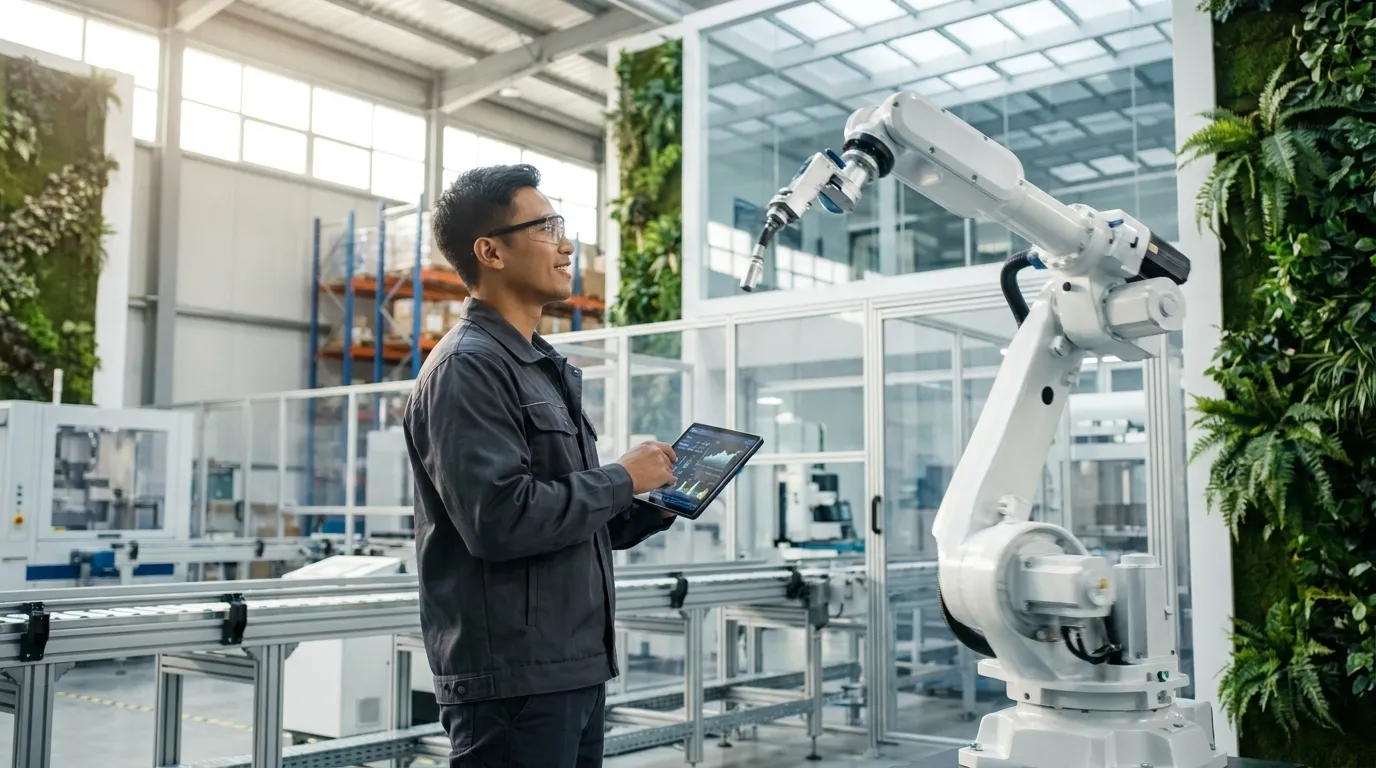
In 2026, the main key for industries to survive and win the global competition is the mastery of artificial intelligence (AI), coding, and robotics focused on production efficiency and environmental conservation (green technology). This "Adapt or Die" era forces companies to immediately transition from manual operations to automated systems, making digital skills an absolute foundation that can no longer be compromised in the modern working world.
Priority Shift: Energy Efficiency and Eco-Friendly Practices
Today's automation has evolved far beyond merely producing goods quickly. Various manufacturing companies are now racing to integrate AI and smart robots to reduce excessive energy use while cutting carbon emissions. Current global market competition highly prioritizes eco-friendly industrial concepts. If a company fails to adapt to these efficiency standards, they are guaranteed to be eliminated from the competition.
An Initial Investment that Pays Off in the Long Run
From a business perspective, shifting to smart systems does require a considerable capital expenditure that drains the pocket. Companies must be ready to purchase robotics equipment, install AI sensors, and build modern software ecosystems. However, this expensive initial investment is highly proportional to the final results. The use of coding and robotics is proven to significantly increase production speed, reduce defect rates, and ultimately reduce long-term operational costs drastically.
Clear Evidence of Global Automation Growth
This shift in industrial trends is supported by very clear numbers. Based on a report from the International Federation of Robotics, the global market value for industrial robot installations has reached US$16.7 billion in 2026. This data also estimates that the number of active industrial robots worldwide has successfully surpassed 5.5 million units. This proves that automation is not merely a nice-to-have innovation, but the primary foundation of today's operations.
China's Total Dominance in the Robotics Market
Looking at the regional power map, China emerges as the country with the most aggressive robotics penetration. In 2024 alone, China successfully installed around 295,000 new industrial robots. This number is incredibly large as it represents about 54% of total global installations. Currently, with a total of 2 million operating robot units, China officially holds the status of the country with the largest robot usage on earth.
Job Market Transformation and Daily Applications
Coding is no longer identical to complicated work done only in dark rooms by a programmer. A basic understanding of algorithms and automation has now become the standard language in the working world. Manual labor jobs are slowly decreasing, replaced by new roles where humans are tasked with supervising systems, reading data, and working alongside artificial intelligence.
We can see concrete examples of these changes in various sectors:
-
Automated Storage Warehouses: Modern warehousing systems no longer require workers to walk long distances to find goods. Software calculates stock in real-time while AI determines the most efficient path to summon robots to deliver product shelves directly to the worker's desk. As a result, millions of orders can be shipped every day with a very minimal error rate.
-
Smart Automotive Factories: On car production lines, AI systems continuously monitor product quality, detect production defects accurately, and control industrial machines so that the work rhythm remains stable.
-
E-Commerce Personalization: In shopping apps, AI works behind the scenes analyzing user search and click history to display relevant product recommendations. Moreover, this algorithm is also tasked with filtering fake reviews, managing automated ads, and blocking accounts indicated to be committing fraud.
Frequently Asked Questions (FAQ)
1. Will AI and robotics really take over all human jobs?
No. Automation does reduce the portion of physical and manual labor, but at the same time creates a vast amount of new career opportunities. Companies now need more data analysts, robot managers, and programming-savvy workers to work alongside AI.
2. What is the estimated number of active industrial robots operating in 2026?
According to data from the International Federation of Robotics, there are a total of around 5.5 million active industrial robot units in use worldwide in 2026.
3. Why are companies willing to pay dearly to install robots and AI?
Even though it requires a very high initial cost (investment), this technology can work faster with an error rate much lower than humans. It is this efficiency that makes the company's operational costs cheaper in the future.
Seeing how fast the industrial landscape is changing, one thing is certain: improving digital skills is the best investment for your future career. Whether for individual needs or team development in a company, understanding the logic behind this technology will keep you relevant in the automation era. Start your adaptation steps now and find the most suitable training program at https://www.kodingakademi.id/.