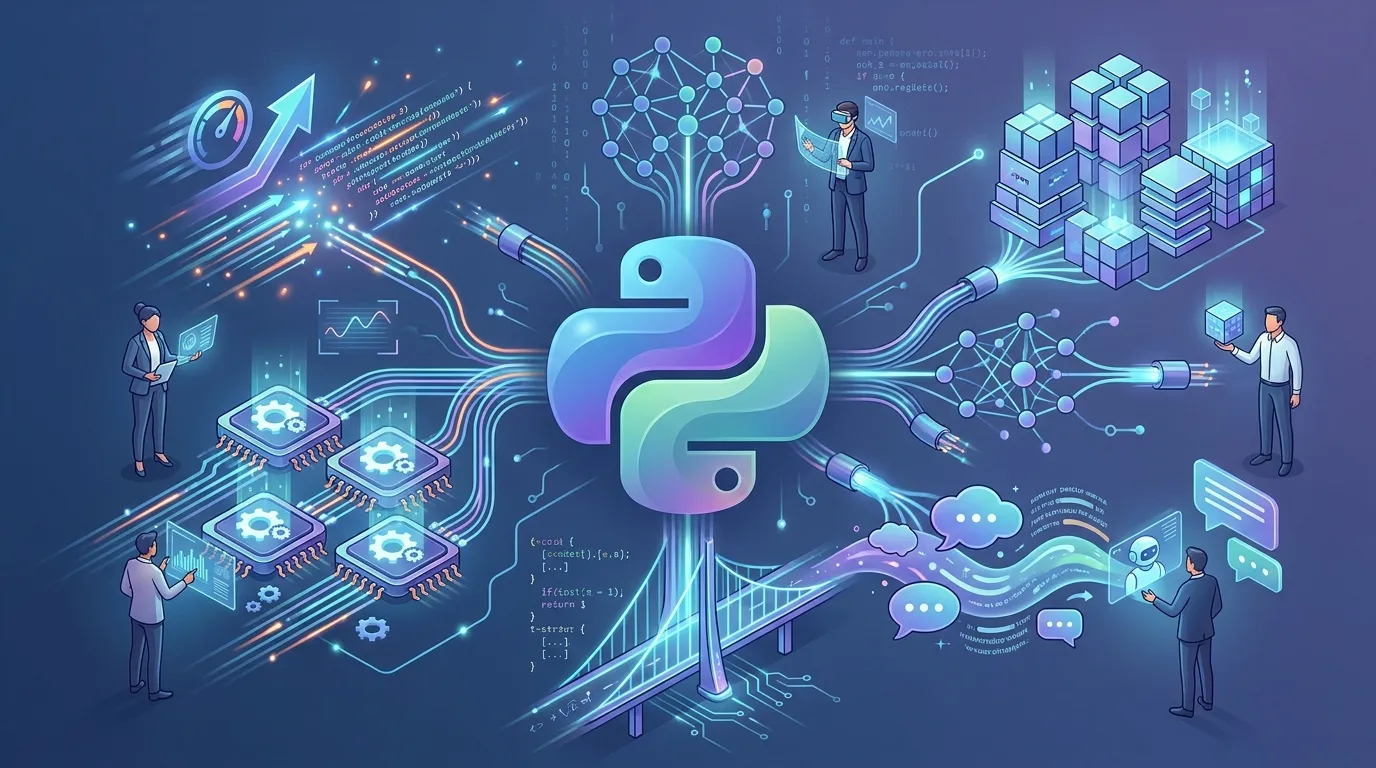
Python 3.14 brings significant breakthroughs to the world of artificial intelligence (AI) by introducing a free-threaded system (without GIL), an experimental JIT compiler, and vastly more stable memory management. These updates technically eliminate the performance bottlenecks that have long haunted developers when running heavy parallel workloads, such as custom machine learning model training and large-scale dataset processing.
Massive Performance Boost and Parallel Execution
One of the reasons Python remains the most sought-after programming language, according to the TIOBE Index and developer surveys, is its ability to adapt to modern hardware needs. In version 3.14, Python finally answers the challenge of multi-core computing.
Adoption of GIL-Free Python (PEP 779)
This is the most anticipated feature by the AI community in decades. Official support for Free-Threaded Python (PEP 779) allows code execution on multi-core CPUs fully in parallel without the bottleneck of the Global Interpreter Lock (GIL). For those who frequently perform batch inference or parallel data processing, this feature will drastically reduce execution time without the wasteful RAM consumption seen in older multiprocessing methods.
JIT Compiler Implementation for Fast Computing
Python 3.14 now includes a Just-In-Time (JIT) compiler in its official release. This technology converts bytecode into machine code while the program is running, giving a speed boost to basic Python logic. This is crucial during the feature engineering stage, where data must be manipulated quickly before being sent to libraries like PyTorch or TensorFlow.
Memory Efficiency for Processing Large Datasets
Handling gigabyte-scale data requires smart resource management so applications don't crash or stutter during the training process.
System Stabilization with Incremental Garbage Collection
The Garbage Collection (GC) system now uses an incremental method that divides object tracking into young and old generations. The result? Latency during memory cleanup is significantly reduced. This ensures that AI workflows involving the loading of large tensors remain stable and have consistent performance over time.
Lightning-Fast Data Access via Zstandard Module
With the built-in compression.zstd module (PEP 784), developers now have access to the Zstandard compression algorithm without needing to install external libraries. Considering that modern AI datasets, especially for LLMs (Large Language Models), are often massive in size, this feature allows loading data from storage to memory much faster while maintaining an optimal compression ratio.
Syntax Flexibility for Modern Prompt Engineering
The needs of the AI industry are not just about numbers, but also about how we interact with models through human language.
Template Strings or t-strings Innovation (PEP 750)
The new t-strings or Template Strings feature is a "gift" for prompt engineering experts. Unlike regular f-strings, t-strings precisely separate static parts and variables. This makes it easier to create complex, secure, and dynamic prompt structures, which is one of the most in-demand tech skills in today's job market according to the World Economic Forum.
Library Import Optimization via Lazy Evaluation
AI libraries like TensorFlow are notoriously heavy when first loaded. With lazy evaluation on type annotations (PEP 649), Python 3.14 will only process type information when it is truly needed. As a result, your AI application's startup time is shorter, and initial memory usage is more efficient.
Frequently Asked Questions (FAQ)
What is the main advantage of Python 3.14 for AI developers?
Speed improvements through the JIT compiler and pure parallel execution capabilities without GIL that make AI data processing much more efficient.
Can the Free-Threaded Python feature be used immediately?
Yes, this feature is available as an option in the Python 3.14 installation, allowing developers to run true multithreading on multi-core CPUs.
Why are t-strings considered important for LLM development?
Because t-strings allow for more structured and safer prompt manipulation compared to regular strings, making them perfect for integration with language models like GPT or Gemini.
The rapid development of Python 3.14 proves that mastering AI technology is no longer just an option, but a primary necessity in today's digital industry. With new features that make optimizing models and processing data increasingly easier, now is the best time for you to deepen your expertise in this field.
Want to master Python and AI technology with an international standard curriculum? Start your learning journey right now with experienced instructors at Koding Akademi. Visit our website for complete course information!